| Home | Nature Weekly Index |
| Last Note | Next Note |
11 October 2026 | Leptopetalum biflorum (Twoflower Mille Graines) | Planthopper |
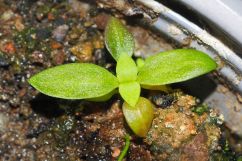 |
| Fig. 1: Seedling of Leptopetalum biflorum on 9 September. |
While nurturing Typhonium roxburghii (Dwarf Voodoo Lily) in a pot in August, I noticed several seedlings emerging from a small, pebble-like clump of compacted soil that I had brought back with the plant. The first was Phyllanthus debilis (Frail Leafflower), which I removed because I currently have no particular interest in it. Two more seedlings soon appeared, and I kept them for observation. Their growth seemed to stall, likely because the Typhonium roxburghii overshadowed them. To identify them, I moved the soil clump to a small pot containing another seedling, later identified as Eclipta prostrata (False Daisy). I placed the clump near the pot’s edge to minimise competition with the existing Eclipta prostrata seedling.
One of the two seedlings on the pebble-like soil did not survive, leaving a single seedling (Fig. 1). After much anticipation, I identified it as Leptopetalum biflorum (Twoflower Mille Graines), formerly known as Oldenlandia biflora. It closely resembled Oldenlandia corymbosa (Old World Diamond Flower) but had broader leaves. Leptopetalum biflorum also appeared to be rarer: when viewed on 11 October 2026, iNaturalist recorded 24 observations of Leptopetalum biflorum and 136 observations ofOldenlandia corymbosa in Singapore.
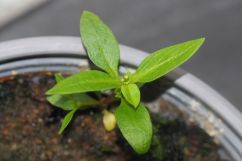
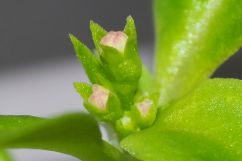
I briefly mentioned Leptopetalum biflorum in a June 2018 post based on a wild specimen. This potted specimen revealed something new to me: a pinkish tint at the tips of the flower buds (Fig. 2). Because I did not associate this feature with Leptopetalum biflorum, I initially questioned the seedling’s identity. Further research led me to Leptopetalum racemosum, a species observed mainly in Taiwan and not in Singapore or nearby countries. A 2019 Taiwanese publication [1] described the flowers of Leptopetalum biflorum as white and “sometimes flushed with purplish pink”, while those of Leptopetalum racemosum were white and “usually flushed with purplish red on the back”. A 2020 publication [2] appeared to treat Leptopetalum racemosum as a synonym of Leptopetalum biflorum. However, both iNaturalist and Plants of the World Online recognise them as separate species.
 |
 |
 |
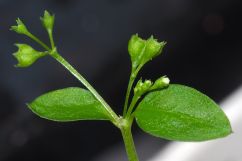 |
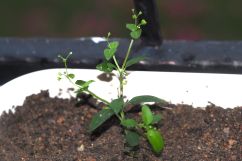
| Fig. 2: Young plant and first few flower buds of Leptopetalum biflorum on 24 September. | Fig. 3: Mature Leptopetalum biflorum collected from the wild on 27 September. | ||
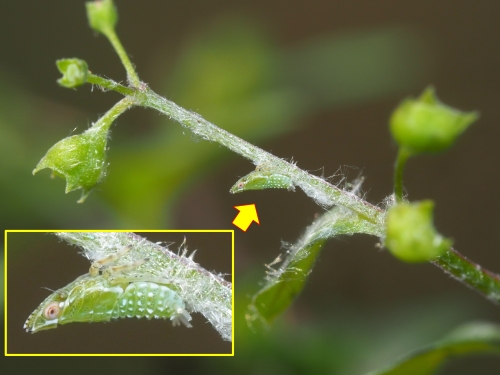 |
| Fig. 4: Nymph of an unknown planthopper on a branch of Leptopetalum biflorum on 4 October. It is smaller than the size of the fruit (capsule) of its host plant. |
For comparison with the potted seedling, I uprooted a mature, flowering and fruiting Leptopetalum biflorum specimen from the wild and placed it in a small pot. The wild specimen (Fig. 3) proved resilient, surviving the disturbance after several days. However, I did not observe any pinkish tint on its existing flower buds. I may need to monitor it longer, until it produces new buds.
On the third day of observing the wild specimen, I noticed a tiny creature on a branch, sparsely covered with whitish material. A closer look revealed a planthopper nymph (superfamily Fulgoroidea), smaller than the fruit (capsule) of Leptopetalum biflorum (Fig. 4). According to the e-Flora of Thailand, the capsule measures 2.5–3.0 by 2.5–3.2 millimetres. By 8 October, the nymph had moved to another branch. I hope it remains on the plant until adulthood so that I can observe the adult planthopper. In any case, I will keep the plant for a while to monitor its new flower buds.
Reference:
[1] Chen DH, Wu MJ. A taxonomic revision of the genus Leptopetalum (Rubiaceae) from Taiwan. J Taiwan Mus 2019;72(1-4):33-53. | Read article |
[2] Ohi-Toma T, Naiki A, Waddell S, Kato H, Dang VS, Murata J. An updated phylogeny of Leptopetalum (Rubiaceae) and taxonomic treatment of herbaceous species in East Asia J Jpn Bot 2020;95(3):141-153. | Read article |